
Boating on the Han River
The old borders of Chu meet the waters of the Three Xiang;
Beyond Jingmen they connect with the many branches of the river.
The river seems to flow beyond earth and sky;
Mountain colours fade in and out of sight.
Towns appear to float by the waterside ahead;
Waves seem to stir the distant sky.
Xiangyang is blessed with lovely weather and scenery;
Let me stay and drink with the governor, like old Shan Jian.
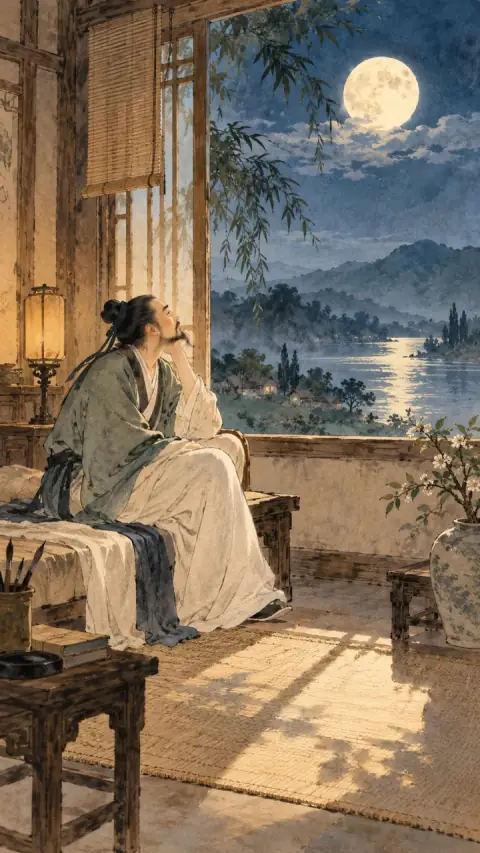
Notes
The Han River is a tributary of the Yangtze. Three Xiang evokes the Xiang River region; Nine Branches suggests the river’s many channels. Shan Weng alludes to Shan Jian, an official associated with Xiangyang and wine, and can refer to a local host.
Meaning
A broad view of the Han River gives way to mountains, waterside towns and moving waves, ending with a wish to stay and drink in Xiangyang.
Appreciation
The opening gathers several geographical names to suggest a wide connected waterscape, not a literal route map.
Read the full appreciationCollapse
The river appears to reach beyond the horizon while the mountains fade in and out of view.
Floating towns and a moving sky convey the impression of watching from water.
The last couplet turns from landscape to companionship through an allusion to Shan Jian.
About the poet
Wang Wei (c. 701–761), courtesy name Mojie, was a Tang poet, painter and official whose family originated near present-day Qixian, Shanxi.
Read about the poetCollapse
He served in government and spent time at Wangchuan; poems exchanged with Pei Di are well known.
His works also include Deer Enclosure and Seeing Yuan Er Off to Anxi.